Key takeaways
- Free learning and a free certificate are not the same thing. Many platforms let you study for free but charge for the certificate.
- Free certificates are currently offered by Elements of AI (Introduction to AI), Kaggle Learn, IBM SkillsBuild, CS50's own certificate for CS50 AI, the Hugging Face Agents course, and Anthropic Academy.
- In August 2025, Coursera replaced free auditing with a free preview of the first module of nearly every course, so full Coursera courses and certificates now generally need payment or approved financial aid.
- Recruiters care about what you can do. Pair each certificate with a project, and list only the ones relevant to the job.
- Certificate policies change often, so check the provider's current terms before you enroll.
Free vs paid at a glance
| Provider | Learning | Certificate |
|---|---|---|
| Elements of AI | Free | Free for Introduction to AI, paid for Building AI |
| Kaggle Learn | Free | Free certificate of completion |
| IBM SkillsBuild | Free | Free digital badges for many courses |
| CS50 AI (Harvard) | Free | Free CS50 certificate, paid verified edX certificate |
| Hugging Face Agents course | Free | Free |
| Anthropic Academy | Free | Free |
| Microsoft Learn | Free | Free Applied Skills assessments, paid certification exams |
| Coursera, including Google AI Essentials | First module free to preview | Paid, or free with approved financial aid |
| DeepLearning.AI | Course videos free | Pro membership required |
| edX | Free audit with temporary access | Paid verified certificate |
| fast.ai | Free | No certificate |
This reflects each provider's published terms at the time of writing, so confirm before you enroll.
How to pick the right course
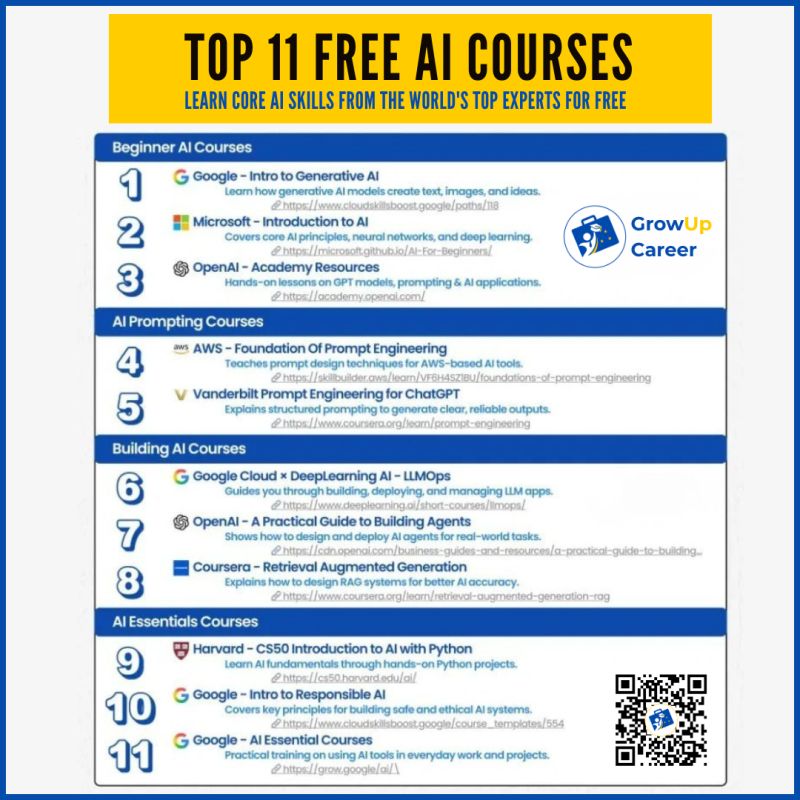
Start from the job you want. For non-technical roles in marketing, HR, operations, or management, choose AI literacy courses such as Elements of AI, Google AI Essentials, or Anthropic's AI Fluency course. For analysts and developers, choose hands-on options like Kaggle Learn, CS50 AI, fast.ai, or Hugging Face, which expect some Python.
Check who issues the credential. A certificate from a recognized university, technology company, or established platform carries more weight, especially when it comes with a verification link or a digital badge.
Look for projects. A course that ends with something you built gives you a portfolio piece and an interview story. Watching videos alone does not.
Be realistic about time. A short literacy course takes an afternoon or a weekend, while CS50 AI or fast.ai can take several months of evenings. Finishing one serious course beats starting five.
Confirm the cost before you start. Read the certificate terms on the enrollment page rather than a third-party blog, because policies change.
How to show AI courses on your CV and LinkedIn
On your CV, list relevant certificates under Certifications in a consistent format with the course name, issuer, and month and year, for example "Intro to Machine Learning - Kaggle, Mar 2026". Three to five relevant entries are plenty.
The stronger move is a Projects entry that shows what you did with the course: "Built a sentiment classifier for 5,000 Bangla-English product reviews in Python with scikit-learn after completing Kaggle's Intro to Machine Learning, reaching 84% accuracy on a held-out test set." Then add the actual skills, such as Python, scikit-learn, or prompt design, to your skills section instead of simply writing "AI".
On LinkedIn, add each certificate under Licenses & certifications with its credential ID or URL, feature your best project, and write a short post about what you built. Our LinkedIn profile checklist covers where each item belongs, and the ATS-friendly resume guide covers CV formatting.
A few things to avoid:
- Listing twenty certificates. It looks like collecting, not learning.
- Listing a course in progress as completed. Write "in progress" instead.
- Calling a certificate of completion a "certification". That word usually means a proctored exam, such as those from Microsoft, AWS, or Google Cloud, and recruiters notice the difference.
If you are not sure which skills to build for your next move, a career coaching session can help you choose.
Links in this resource
- Elements of AIFree beginner courses from the University of Helsinki and MinnaLearn; the Introduction to AI certificate is free, while the Building AI certificate is paid.elementsofai.com
- Kaggle LearnFree hands-on micro-courses in Python, pandas, machine learning, and SQL that run in the browser and award free certificates of completion.kaggle.com
- IBM SkillsBuildFree courses on AI fundamentals and generative AI, with digital badges issued through Credly for many completed courses.skillsbuild.org
- Harvard CS50Home of CS50's Introduction to AI with Python; CS50 issues a free certificate if you score at least 70% on every project, while the verified edX certificate is paid.cs50.harvard.edu
- Hugging Face LearnFree courses on LLMs, agents, and open-source AI tools; the Agents course awards a free fundamentals certificate after Unit 1 and a free completion certificate after the final challenge.huggingface.co
- Anthropic AcademyFree courses on AI fluency and building with Claude, each issuing a certificate after the final assessment.anthropic.skilljar.com
- Microsoft LearnFree modules and learning paths on AI and Azure AI services; Applied Skills credentials use a free lab-based assessment, while certification exams are paid.learn.microsoft.com
- Google SkillsGoogle's learning platform for AI and cloud, combining Google Cloud, DeepMind, and Grow with Google content, with many no-cost courses and labs.skills.google
- Grow with GoogleHome of Google AI Essentials and the Google Career Certificates, which run on Coursera, where the certificate needs a paid subscription or approved financial aid.grow.google
- CourseraUniversity and industry AI courses, including DeepLearning.AI programs; the first module is free to preview, while full access and certificates need payment or financial aid.coursera.org
- DeepLearning.AIShort courses on generative AI and agents; free members can watch course videos, while quizzes, labs, and certificates need a Pro membership.deeplearning.ai
- edXUniversity AI courses with a free audit track that gives temporary access without graded work or a certificate; verified certificates are paid.edx.org
- AWS Skill BuilderFree digital courses on AWS and generative AI fundamentals; AWS Certification exams are paid.skillbuilder.aws
- fast.aiFree practical deep learning courses for coders; there is no certificate, so the projects you build are the proof.fast.ai
- LinkedIn LearningSubscription course library that sometimes makes selected AI courses free for a limited time; completion certificates can be added straight to your profile.linkedin.com
Links open the official site. Some partner links may earn us a commission at no cost to you — see our disclosure.
FAQ
Are free AI certificates worth adding to a resume?
Yes, if they relate to the job and you can talk about what you learned. A certificate backed by a project carries far more weight than a list of course names.
Is Google AI Essentials free?
You can preview the course, and Google and its partners sometimes fund access, but the certificate on Coursera usually requires a paid subscription or approved financial aid. Check Grow with Google for current offers.
What is the difference between a certificate and a certification?
A certificate of completion shows you finished a course. A certification usually means you passed a proctored exam from a body such as Microsoft, AWS, or Google Cloud, and those exams are typically paid.
Which free AI course should a complete beginner start with?
Elements of AI or Anthropic's AI Fluency course if you are non-technical, and Kaggle Learn's Python and Intro to Machine Learning courses if you want hands-on skills.