Key takeaways
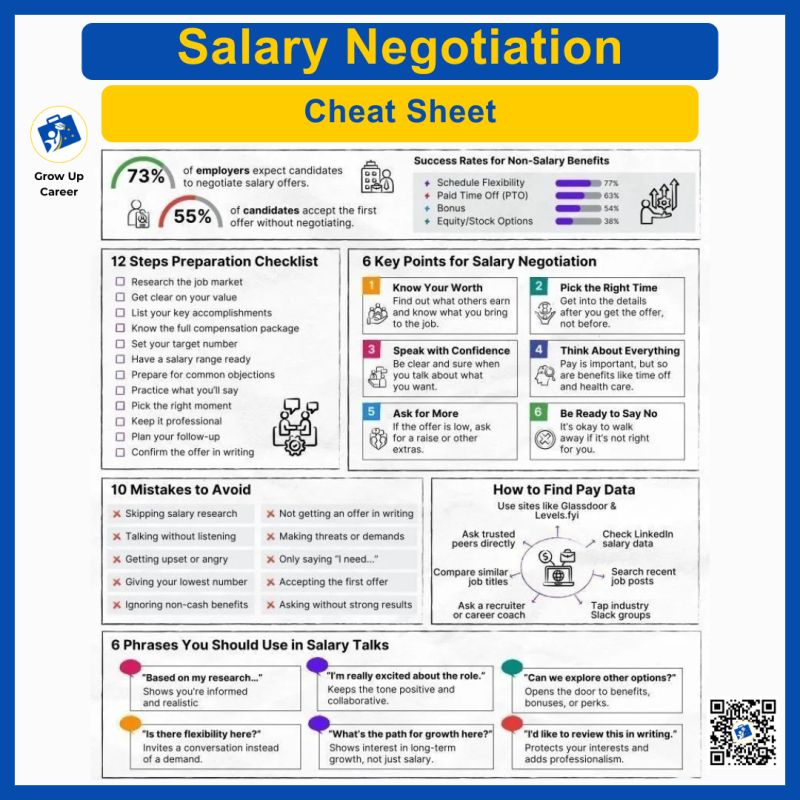
- Research a range from at least three sources before the first call, and decide your target and walk-away numbers in advance.
- Let the employer share a number first when you can. When you can't, give a researched range whose lower end you would genuinely accept.
- Negotiate the whole package in one conversation: base, bonus, allowances, leave, remote days, and the date of your first salary review.
- Counter in writing, politely, with one clear number and the reason behind it. A reasoned counter is a normal part of hiring.
- Never invent a competing offer, and never issue an ultimatum you are not prepared to carry out.
Research your range first
Collect numbers from salary sites (Glassdoor and Payscale for most roles, Levels.fyi for tech), job postings that publish ranges, recruiters, and people currently doing the job. Pay transparency is spreading: several US states and cities require ranges in job ads, and the EU Pay Transparency Directive is pushing employers to share pay ranges before interviews and stop asking about salary history, though each country is applying it on its own timeline. For local roles in Bangladesh, where public salary data is thin, two or three conversations with people a level above you are often the most reliable source.
Then fix three numbers: your target, an opening ask slightly above it, and your walk-away point.
Know how pay is structured where you are applying:
- Bangladesh: gross salary is usually split into basic, house rent, medical, and conveyance. Festival bonuses and provident fund contributions are often calculated on basic, so ask for the breakdown, not just the gross.
- Gulf: compare basic salary, housing, and transport allowances separately. End-of-service benefits are often tied to basic pay, so a low-basic, high-allowance offer can be worth less than it looks.
- UK, Europe, and North America: look at base, bonus, pension or retirement matching, health cover, and equity.
The free job offer comparison calculator puts two offers side by side, including allowances and bonuses.
When to talk numbers
- Application forms often ask for present and expected salary. If a form forces a single number, enter your target, not your floor.
- Recruiter screen: ask for their range first. Many recruiters will share one if you ask directly.
- After the final interview or a written offer: this is when you have the most leverage, because they have already decided they want you.
- Internal raises: ask four to eight weeks before budgets are set, not after the review cycle closes.
Scripts you can use word for word
Answering "What is your expected salary?"
Early in the process: "I'd like to understand the scope of the role and the full package first. Could you share the budgeted range for this position?"
If pressed, experienced: "Based on my research for similar roles in [city or industry] and my experience with [key skill], I'm targeting [X] to [Y] gross per month. I'm flexible depending on the bonus, allowances, and growth path. Does that fit your range?"
If pressed, fresher: "For entry-level [role] positions, I've seen offers in the [X] to [Y] range. The learning in this role matters a lot to me, so I'm open to a number within that range."
If asked for your current salary: "My current gross is [X], plus [bonuses or benefits]. Given the added responsibility of [scope], I'm looking for [Y] to [Z] for this role."
Countering an offer by email
Subject: [Your Name] - Offer for [Job Title]
Dear [Name],
Thank you for the offer for the [Job Title] role. I'm excited about [specific team goal or product], and I want to make this work.
After reviewing the full package, I'd like to ask whether there is flexibility on the base salary. Based on [market data for similar roles, or the scope we discussed], I was expecting a base of [number]. If we can reach [number], I'm ready to confirm my acceptance by [date].
Thank you again. I look forward to your thoughts.
Best regards,
[Your Name]
Only include the "ready to confirm" line if you mean it. It is a strong signal, and the employer will hold you to it.
Negotiating benefits when the base is fixed
"I understand the base is set by the salary band. Could we look at other parts of the package? The items that matter most to me are [a joining bonus, a salary review after six months, two remote days a week, or a training budget for a certification]. Which of those might be possible?"
Items that are often easier to move than base pay:
- A joining bonus, or a buyout of your notice period
- A written salary review at six months with agreed criteria
- Job title or level
- Remote or hybrid days
- A training or certification budget
- Extra annual leave or a later start date
- A laptop, internet, or mobile allowance
Whatever you agree, get it in the offer letter or in an email from HR.
Asking for a raise internally
Prepare a one-page summary of your results from the last 6 to 12 months: projects delivered, money saved or earned, responsibilities you took on, and people you trained. Add market data for your role, then book a meeting rather than raising it in passing.
"I'd like to talk about my compensation. Over the past year, I've [taken over X, delivered Y, trained Z new joiners]. Based on that scope and market data for similar roles, I'd like to discuss moving my salary to [number]. What would it take to get there in this review cycle?"
If the answer is no: "I understand the budget is tight this cycle. Could we agree on specific goals and a date to revisit this, say in three months, and put that in writing?"
What not to say
- "I'll take whatever you think is fair." It hands over the decision.
- "I need more because my rent went up." Your costs are not the employer's reason to pay more; your value is.
- "That's too low" with no number attached. Always counter with a figure.
- A competing offer you don't have. Recruiters talk, and some will ask to see the letter.
- An ultimatum you won't follow through on.
- A verbal yes on the spot. Say instead: "Thank you, I'm excited about this. Could I have until [day] to review the full offer?"
- An apology for asking. A calm, reasoned request is professional, not rude.
Before a big conversation, a session of career coaching and consulting gives you a safe place to rehearse. The results you gather for a raise also make strong interview stories, as our STAR method examples show.
Links in this resource
- GlassdoorEmployee-submitted salary reports and company reviews, most useful for larger and multinational employers.glassdoor.com
- PayscaleSalary data by job title, experience, and location, based on its own salary survey.payscale.com
- Levels.fyiDetailed pay data for software, product, and data roles, including bonus and equity.levels.fyi
- NumbeoCrowd-sourced cost-of-living comparisons for weighing offers in different cities.numbeo.com
Links open the official site. Some partner links may earn us a commission at no cost to you — see our disclosure.
FAQ
Can negotiating get my offer withdrawn?
A polite, well-reasoned request rarely causes problems. Offers are far more often lost over ultimatums, dishonesty, or an aggressive tone than over a reasonable counter.
How much higher should my counteroffer be?
Base it on your research, not a fixed percentage. A counter that sits within the market range and comes with a clear reason is easier for a hiring manager to approve.
Should freshers negotiate salary?
Yes, carefully. Structured graduate or trainee programs often have fixed pay, but you can still ask about the joining date, training, or when the first salary review happens.
What if the employer insists on knowing my current salary?
Share your gross pay and main benefits honestly, then move the conversation to what you expect for the new role. Where salary history questions are restricted by law, you can politely decline.