Key takeaways
- Most resumes are rejected because the match to the job is not obvious in a quick skim, not because of one fatal error.
- Selected resumes lead with the target role, prove results with numbers, and use the job description's language.
- Two-column templates, graphics, and scanned PDFs can hide your experience from the ATS before a recruiter ever reads it.
- Knockout criteria such as location, a required degree or license, and notice period cause many rejections. Address them directly where you can.
- Fix the top third of page one first. That is where a recruiter decides whether to keep reading.
What a recruiter checks in the first skim
Before reading any bullet in detail, most recruiters look for the same handful of signals:
- Your most recent job title and employer, and whether they resemble the role
- How long you stayed in each role, and whether your responsibilities grew
- Your location, and whether it fits the job's requirements
- The two or three must-have skills or qualifications from the posting
- Something that proves results, such as a number, a client, a project, or a portfolio link
If those signals are hard to find, the resume goes into the "no" pile, however strong the details further down are.
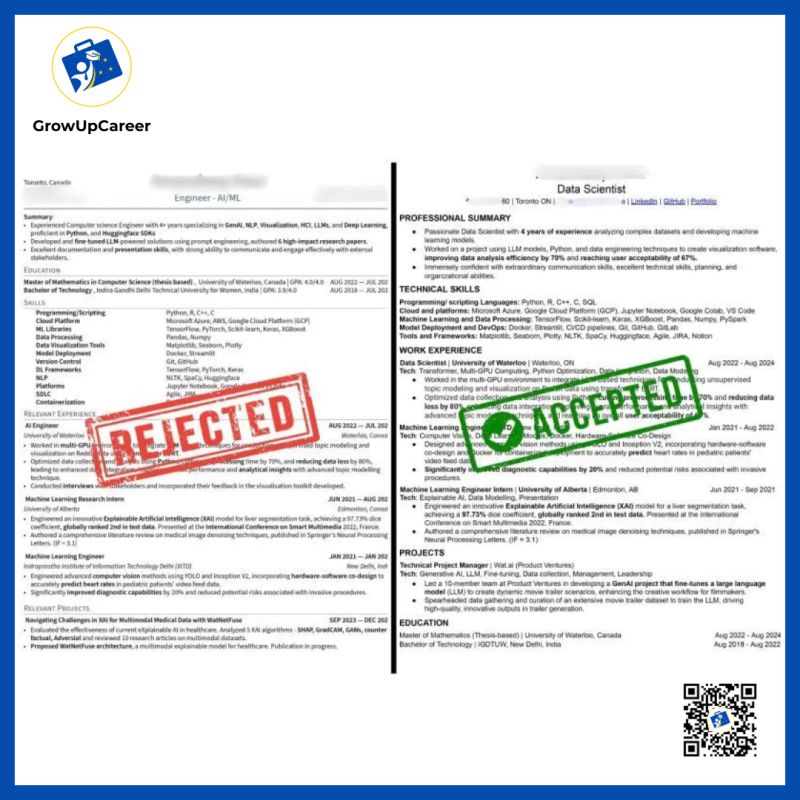
Rejected vs selected, side by side
| Area | Rejected resume | Selected resume |
|---|---|---|
| Top of the page | "Objective: To work in a challenging environment where I can grow" | "Digital Marketing Executive - Meta Ads, GA4, Email Automation" plus two lines of results |
| Bullets | "Responsible for social media pages" | "Grew a skincare brand's monthly Facebook reach from 18K to 65K in 4 months with a 3-post weekly calendar" |
| Keywords | Generic terms like "marketing tools" | The exact tools and titles named in the job post |
| Layout | Two columns, icons, skill bars | Single column, standard headings, real text |
| Length | Three or more pages listing every training course | One to two pages focused on recent, relevant work |
| Personal details | Photo, date of birth, religion, father's name | Name, city, phone, email, LinkedIn URL |
| Skills | "MS Office, hard worker, team player" | "Excel (pivot tables, XLOOKUP), Power BI, SQL basics" |
| Proof | Nothing beyond job titles | A portfolio, GitHub, or case study link |
| File | A scanned image named "CV final new (2).pdf" | A text-based PDF named "Nusrat-Jahan-Resume.pdf" |
10 common rejection reasons and how to fix them
1. The same resume goes to every job
Recruiters can tell when a resume was not written for their role. Fix: keep a master version and tailor the headline, summary, skills order, and three to five bullets for each application.
2. Bullets describe duties instead of results
"Responsible for accounts payable" says what the job was, not how well you did it. Fix: rewrite each bullet as action, method, and result, such as "Cleared a 400-invoice backlog in six weeks and set up a weekly payment run that ended late-payment penalties."
3. The format breaks the ATS
Columns, tables, text boxes, and icons can scramble or hide your content. Fix: use a single-column layout with standard headings, as explained in our ATS-friendly resume guide.
4. Must-have requirements are missing or buried
If the post asks for an ACCA qualification, a driving license, or three years of B2B sales, and the recruiter has to hunt for it, you will lose to someone who states it plainly. Fix: mirror each requirement you meet in your summary or skills section, using the posting's wording. If you are moving to the job's city, say so in your summary, for example "Relocating to Chattogram in January 2027".
5. The top third doesn't say who you are
An objective statement about wanting growth tells the recruiter nothing about what you offer. Fix: open with your target title, your specialty, and two lines of proof.
6. Typos and inconsistent formatting
A spelling mistake on a resume for a role that asks for "attention to detail" is hard to forgive. Fix: read it aloud, run a spell check, and make sure dates, fonts, and bullet styles are consistent throughout.
7. Gaps or job titles that raise questions
Unexplained gaps and unclear internal titles make recruiters guess, and they rarely guess in your favor. Fix: add a one-line explanation for gaps longer than six months, such as "Career break - family care; completed Google Data Analytics Certificate", and clarify unusual titles in brackets.
8. Too long, too dense, or padded
Three pages covering every training course bury the two achievements that matter. Fix: one page for freshers and most people with under five years of experience, two pages for experienced professionals, with older roles cut to one or two lines.
9. Personal details that don't belong
A photo, date of birth, religion, marital status, and parents' names are common on Bangladeshi CVs, but international and multinational recruiters don't expect them and may read them as a sign of an outdated resume. Fix: remove them unless the posting explicitly asks, and never include your NID or passport number.
10. Contact details or LinkedIn that don't check out
An old nickname email address, a broken LinkedIn link, or dates that don't match your LinkedIn profile all cost trust. Fix: use a simple firstname.lastname email, test every link, and make sure your LinkedIn matches your resume.
A 20-minute fix order
- Rewrite the headline and summary for the specific job.
- Reorder your skills so the posting's must-haves come first.
- Rewrite your five most recent bullets with results.
- Remove personal details and anything older than 10 to 15 years that isn't relevant.
- Run the file through the free ATS resume checker.
- Get a second opinion with a free CV and LinkedIn audit.
If you would rather hand the rewrite over, our ATS resume and CV writing service rebuilds it around your target role.
FAQ
How do I know if the ATS rejected my resume?
Usually you can't. A rejection email that arrives within minutes typically points to a knockout question in the application form, such as location or years of experience, rather than the resume itself.
Why do I get no response even when I'm qualified?
Common causes are applying late, internal candidates, high applicant volume, or a match that isn't visible in a quick skim. Apply in the first few days, tailor the top third, and ask for referrals where you can.
Should I remove my photo from my resume?
For international and most multinational roles, yes. Keep it only when a local or Gulf employer explicitly requests one.
Is a one-page resume always better?
No. One page suits students, freshers, and most people with under five years of experience. Experienced professionals can use two pages if every line is relevant.